Beyond the Checklist: Why Property Validation (IDS) Fails Real-World BIM Compliance
How Digital Twins and Computational Geometry Break Through the "IDS Ceiling"
Document Reference: CCSMK-CCS-MKT-ZZ-DS-BG-0003
Series: The Future of Automated Model Checking (Part 1 of 8)
Author: C&C Solutions (CCS) with Delivery Partners
Date: 2026-10-14
Target Channels: LinkedIn Native Article (Pulse), candcsolutions.co.uk Authority Blog
Proof Dataset: IFC Hospital iTwin Benchmark
If you ask most BIM managers how they validate a digital model today, they will show you a green dashboard.
Every wall has an acoustic rating property. Every door has a manufacturer code. Every room has an OmniClass or Uniclass code. Under buildingSMART’s Information Delivery Specification (IDS)—the open standard for defining machine-readable information requirements—the model scores a proud 100%.
Then the project breaks ground.
The hospital corridors turn out to have sub-statutory clear widths because door stops, architraves, and wall-mounted medical services encroach into the walking route. The mechanical ductwork under the floor slab cuts headroom down to 1.95 meters. And the total gross floor area exceeds the statutory planning permit by 8.4%.
How can a model be 100% compliant with information standards, yet fundamentally fail regulatory, physical, and contractual requirements?
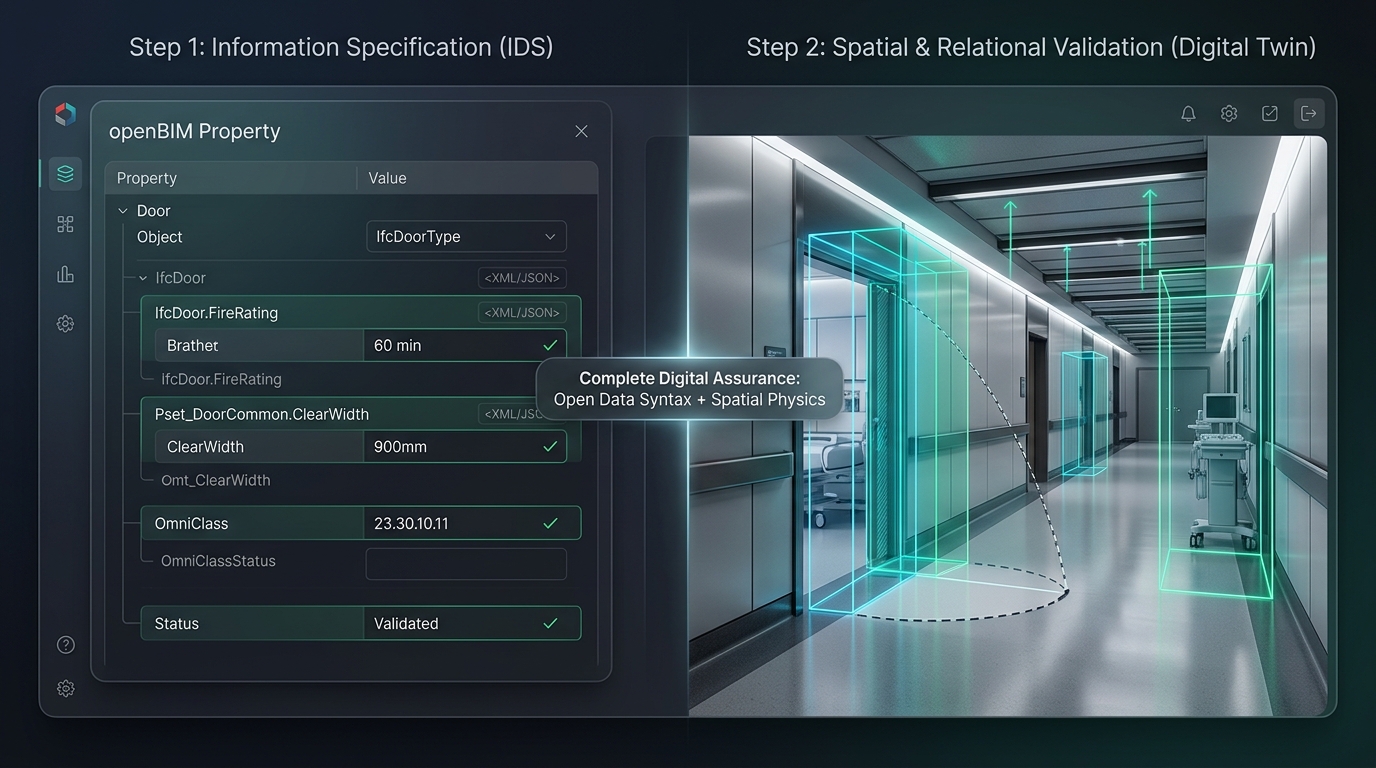
Two Pillars of Complete BIM Assurance: Data Syntax Meets Spatial Reality
Over the past decade, the architecture, engineering, and construction (AEC) industry has made incredible strides in standardizing metadata. Standards like ISO 19650 and buildingSMART’s Information Delivery Specification (IDS) have given clients and information managers a structured, open-standard way to specify what data elements should carry.
IDS is an elegant, open-standard solution for a very specific and vital problem: syntax verification. It ensures that when a client asks for an IfcDoor with a property named FireRating formatted as an alphanumeric string, the authoring software outputs it cleanly.
This foundation is essential—without clean, standardized properties, reliable digital workflows simply cannot scale.
However, verifying information requirements is Step 1 of a two-step assurance process:
- Step 1 (Information Delivery Specification / IDS) verifies: "Did the designer provide the required data in the correct open standard format?"
- Step 2 (Spatial & Relational Digital Twin) verifies: "Does the design work in the real physical world, and does it satisfy statutory and contractual engineering rules?"
While Step 1 ensures the data is present, Step 2 answers the deeper engineering questions:
- "Is the value physically possible in the real world?"
- "Does the door swing create a dangerous choke point during emergency evacuation?"
- "Does the 60-minute compartment wall actually connect seamlessly to the structural deck, or does an unrated service penetration punch a hole through it?"
- "Does the sum of all individual room areas comply with the client’s approved planning brief?"
Answering these questions does not replace IDS—it builds directly upon it, pairing open data specifications with computational, relational, and spatial digital twin intelligence.
Where Data Meets Spatial Physics: The Three Complementary Frontiers
Why do information managers need spatial digital twins alongside their IDS specifications? Because real-world engineering rules operate across three natural dimensions that transcend isolated property fields:
1. The Relational Dimension (Cross-Element Intelligence)
IDS evaluates elements individually. It can inspect Room 104 and confirm that its measured area property is populated and valid.
The spatial twin completes the equation by traversing the project hierarchy: querying the root Project element to read the approved planning brief limit, aggregating the areas of all 650 rooms across four storeys, and verifying that the collective whole respects statutory municipal envelopes.
2. The Physical Geometry Dimension (Effective Clearances & Swings)
A property sheet might declare that a door is 1000mm wide. But functional accessibility and fire safety require measuring the effective clear opening width—subtracting frame rebates, door stops, and door leaf thickness at 90 degrees.
By analyzing the door within the 3D twin, we can sweep its dynamic swing trajectory to verify it doesn't collide with structural columns, corridor handrails, or medical equipment.
3. The Spatial Volume Dimension (Headroom & Evacuation Envelopes)
Headroom, corridor clearance, and evacuation routes are not made of concrete or steel—they are volumes of space.
When upstream design models omit explicit IfcSpace volumes, digital twin rule handlers can programmatically reconstruct these virtual clearance boxes on the fly, testing them against multi-disciplinary structures and services.
How Connected Digital Twins Complete the Picture
To bridge this boundary, C&C Solutions in partnership with technology leaders, developed bim-checker on the Bentley iTwin platform.
This was all built on our standard development framework which is the basis for our toolbox and digital index applications.
Instead of treating BIM files as static collections of isolated geometric shapes and text tags, bim-checker indexes models into a cloud-native relational graph. Using ECSQL (an SQL-based query language operating over digital twin schemas) combined with browser-native computational geometry, we can evaluate rules that were previously impossible to automate:
- Cross-Element Relational Aggregation: We can dynamically compare design execution against high-level briefing limits stored at project or facility level.
- Dynamic Spatial Synthesis: When upstream models lack explicit spatial volumes (which happens on almost every real-world project), our rule handlers programmatically generate 3D clearance boxes—such as walking corridors or door clearances—and clash them against multidisciplinary geometry.
- Continuous Web-Native Auditing: Rather than requiring gigabytes of desktop software licenses on every engineer's workstation, audits run in the cloud with defects displayed directly in the web browser.
What’s Coming Next
Over the next four weeks, we are pulling back the curtain on this new generation of automated model checking across an 8-part article series:
- Beyond the Checklist (This article)
- The Planned vs. Actual Dilemma: Gross Floor Area checks across element hierarchies.
- The 900mm Illusion: Evaluating real door clearances and 3D swing envelopes.
- Headroom, Drops, and Fire Barriers: Dynamic spatial intersections in complex facilities.
- The Linear Leap: Why vertical building rules collapse on linear rail and highway infrastructure.
- The Stepping Distance Dilemma: Validating the Platform-to-Train Interface (PTI) and copers in 3D.
- Airspace Along the Line: Overhead footbridges, dynamic structure gauges, and boundary fencing.
- Where Civil Meets Systems: High-voltage electrical clearances (OCLZ/CCZ) and track slab integration.
We will demonstrate these principles using real-world, open benchmark datasets: the IFC Hospital iTwin for complex multi-storey buildings, and the Dinsdale to Allens West Rail Corridor for linear infrastructure.
Real quality assurance is achieved when we pair open information specifications with spatial and relational reality. When syntax meets physics, digital twins deliver on their true promise.
Join the Discussion
- How is your organisation currently verifying spatial and relational compliance in your BIM models?
- Are your QA/QC dashboards catching physical site coordination issues, or are you still relying on manual drawing reviews?
👇 Share your thoughts in the comments below, or connect with C&C Solutions to learn more about automated validation on Bentley iTwin.
#OpenBIM #BIMValidation #DigitalTwins #BentleyiTwin #buildingSMART #AEC #EngineeringExcellence #InformationManagement #ISO19650 #DigitalIndex